
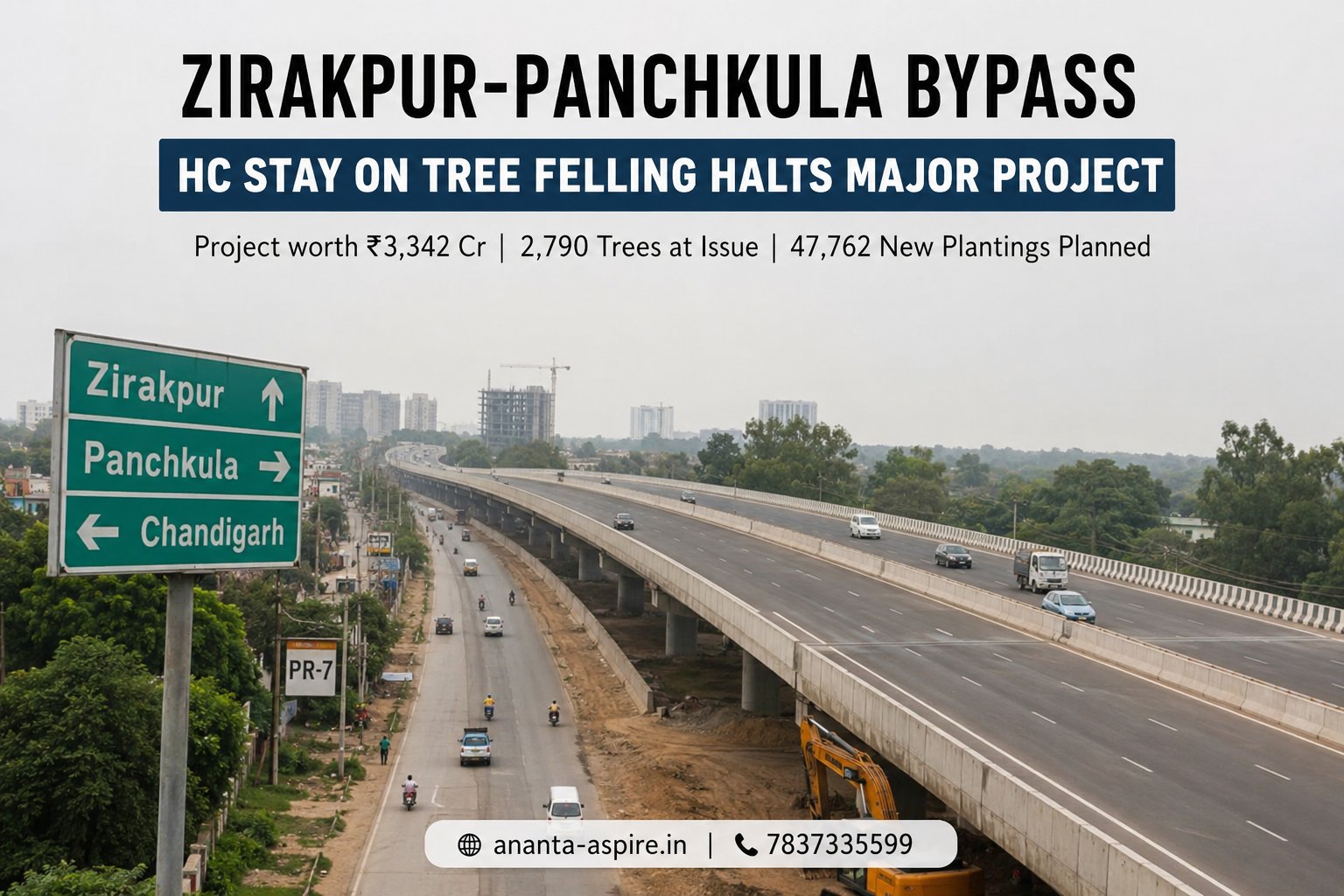
19.2 km Bypass Length 6-lane expressway | ₹1,878 Cr Project Cost Bypass alone | 2,790 Trees at Issue Per NHAI's count | 47,762 New Plantings 17:1 replacement ratio |
A single court order on May 25, 2026 halted whFREat was meant to be the Tricity's most transformative highway project. Here is the full story - what led to this moment, what is genuinely at stake and what it means for the millions of people whose lives orbit this corridor.
The Project: A Highway Six Lanes Wide and Twenty Years in the Making
To grasp why the HC stay hit so hard, you first need to understand what was about to begin. The Zirakpur-Panchkula Bypass is not simply a road. It is a 19.2-kilometre, six-lane, access-controlled expressway conceived specifically to extract through-traffic from the strangled urban grid of Zirakpur and Panchkula - two of the most congested zones in northern India's otherwise well-planned Tricity region.
Sanctioned under the Bharatmala Pariyojana - India's flagship national highway expansion programme - and administered by the National Highways Authority of India (NHAI), the project carries a price tag of Rs 1,878 crore. Its route begins near Chandigarh International Airport, which also operates as an Indian Air Force Station and concludes at Chandimandir, Panchkula, the seat of the Indian Army's Western Command. A companion Greenfield Spur, stretching 10.3 kilometres at an additional Rs 1,464 crore, completes the vision.
| Specification | Detail |
| Corridor Name | Zirakpur-Panchkula Bypass + Greenfield Spur |
| Bypass Length | 19.2 km |
| Spur Length | 10.3 km |
| Lane Configuration | Six-lane, fully access-controlled |
| Bypass Contract Value | Rs 1,380 Crore - awarded to RKCPL Limited (2-year window) |
| Spur Contract Value | Rs 603 Crore - awarded to Ceigall Infra Projects (18-month window) |
| Origin | Chandigarh International Airport / IAF Station |
| Destination | Chandimandir Military Station - Western Army Command HQ |
| Programme | NHAI under Bharatmala Pariyojana |
| Forest Clearances | Stage-I and Stage-II - obtained from MoEF&CC |
| Defence Land | 2.7461 acres at Chandimandir - cleared May 2026 |
| Elevated Section | 6.195 km through forested zones to reduce tree felling |
The Court Order: What the HC Actually Did and Why
For years, the bypass was stalled by a succession of clearance battles - forest approvals, wildlife assessments, land acquisition and, most recently, a Ministry of Defence sign-off for 2.7461 acres of army-controlled land at Chandimandir. By early May 2026, NHAI had finally cleared every last hurdle. Construction was imminent.
Then came May 25. A Public Interest Litigation filed before the Punjab and Haryana High Court triggered a sweeping directive: no trees may be felled anywhere in the state of Haryana without the court's express authorisation. The PIL alleged that approximately 5,000 trees stood in the path of the bypass. NHAI, responding formally to the court, placed the actual number of forest trees proposed for removal at 2,790 - substantially fewer than the figure cited in the petition.
WHAT THE COURT ORDERED A blanket prohibition on tree felling across the entire state of Haryana, pending judicial review.
Case Status: Scheduled for next hearing - date to be confirmed Scope: State-wide, not limited to the bypass corridor PIL's Claim: Approximately 5,000 trees to be removed NHAI's Counter: 2,790 forest trees - all covered by valid statutory clearances |
The Environmental Ledger: NHAI's Case in Full
Critics of the project ask a fair question: is the removal of any trees - however many - truly justified? NHAI's answer, submitted before the High Court, rests on three pillars: legal clearance, ecological offset and thoughtful design.
| Environmental Metric | NHAI's Position |
| Forest Trees Proposed for Removal | 2,790 (versus ~5,000 alleged in the PIL) |
| Regulatory Clearances Held | Stage-I and Stage-II Forest Clearances from MoEF&CC |
| Wildlife Oversight | Full mitigation plan reviewed and cleared by Wildlife Institute of India, Dehradun |
| Statutory Compensatory Planting | 27,770 trees under government schemes |
| Avenue Plantation Along Route | 12,000 trees |
| Corridor Shrub Planting | 7,992 shrubs |
| Total New Vegetation Committed | 47,762 plantings - a 17:1 ratio against removals |
| Financial Commitment | Net Present Value and afforestation funds deposited with MoEF&CC |
| Design Adaptation | 6.195 km elevated to minimise ground-level tree loss |
Put plainly: the project is designed to give back seventeen plants for every one removed. The elevated corridor - built at significant additional cost - is a direct engineering response to the imperative of preserving tree cover wherever structurally possible.
THREE QUESTIONS, THREE ANSWERS
Are statutory forest clearances in place? YES - Stage-I and Stage-II from MoEF&CC. Is replanting formally committed and funded? YES - 47,762 plantings at a 17:1 ratio. Was independent ecological review conducted? YES - Wildlife Institute of India, Dehradun. |
The Petitioners' Case: Why the PIL Has Merit Too
Dismissing the PIL as obstructionism would be unfair. The citizens who approached the court carry real, evidence-based anxieties - and they speak for many others in the Tricity who have watched green cover shrink year after year.
The Shivalik foothills abutting Panchkula and the Morni Hills form one of the last meaningful natural forest corridors in an otherwise heavily developed urban region. These ecosystems deliver services - flood buffering, groundwater recharge, air filtration, biodiversity habitat - that no compensatory plantation can replicate on a short timeline. Mature trees take decades to grow. Saplings planted today will not perform the same ecological functions for a generation.
There is also a legitimate transparency concern. The gap between 5,000 and 2,790 trees does not automatically mean anyone is lying - it may reflect different methodologies, different definitions of 'forest tree' versus roadside vegetation, or incomplete public disclosure. But it does mean that no single, independently verified, publicly accessible figure exists. That is a governance failure the court is right to scrutinise.
And the stay is broader than just this bypass. A state-wide prohibition on tree felling suggests the HC sees a systemic pattern in Haryana - a pace of forest diversion that warrants judicial oversight across all projects, not just this one.
The Strategic Argument: Why This Particular Road Cannot Wait
A National Security Corridor in Disguise
Most people experience this project as a traffic fix. But its two endpoints tell a different story. The bypass begins at Chandigarh International Airport - jointly operated by the Indian Air Force - and terminates at Chandimandir Military Station, the operational home of the Western Army Command. The corridor between these two installations currently runs through dense urban streets with traffic lights, residential intersections and commercial zones.
In a border state where rapid force mobilisation can become a real-world requirement with minimal warning, a congestion-free, access-controlled defence logistics corridor is not a convenience. It is a strategic necessity. The Ministry of Defence's decision to release 2.7461 acres of army land for this project signals how seriously the defence establishment views its importance.
The Traffic Equation
Every vehicle travelling from Delhi, Ambala or Patiala towards Shimla, Baddi, Chandigarh or Panchkula currently has no choice but to crawl through Zirakpur. The town was never designed for this load. Its junctions - Gol Market, Kalka Chowk, the VIP Road intersections - are chokepoints that routinely add 20 to 30 minutes to journeys that should take five. The bypass eliminates this entirely for through-traffic, redirecting it onto an access-controlled corridor that bypasses the urban core completely.
The downstream effects matter too: lower fuel consumption from reduced idling, measurably better air quality in Zirakpur and Panchkula's residential areas and faster emergency response times to institutions like Fortis Hospital Mohali and PGIMER Chandigarh.
The Financial Cost of Standing Still
Delay is not free. The Greenfield Spur component alone ballooned from an original estimate of Rs 940 crore to Rs 1,464 crore - a 56% cost increase accumulated across the years since the project was first drawn up in 2020. Every month of further delay adds to this burden. Construction inflation, financing costs and compounding land acquisition expenses are borne ultimately by taxpayers. The HC stay is a legal necessity - but its financial cost is real.
How We Got Here: The Full Timeline
| Date / Period | What Happened |
| 2020 | Bypass conceived as part of the Bharatmala Pariyojana |
| 2020 – 2024 | Prolonged wait: forest clearances, land disputes, bureaucratic backlogs |
| June 2025 | NHAI floats fresh tenders; technical bid openings delayed six consecutive times |
| January 2026 | Final Stage-2 Forest Clearance issued by MoEF&CC - a six-year milestone |
| January 29, 2026 | Technical bids opened; RKCPL Ltd and Ceigall Infra awarded contracts |
| February 2026 | Union Government approves the Rs 1,464 crore Greenfield Spur |
| May 2026 | Ministry of Defence grants clearance for 2.7461 acres at Chandimandir |
| May 25, 2026 | Punjab & Haryana HC issues blanket stay on all tree felling in Haryana |
| Present | Project suspended; NHAI reply filed; next hearing awaited |
Who Bears the Cost of This Pause?
A highway stay order might sound like an abstract legal event. Its consequences are anything but.
For Daily Commuters
• Gridlock at Zirakpur's main junctions - Gol Market, Kalka Chowk, VIP Road - will continue unabated.
• Long-haul trucks serving the Baddi-Barotiwala-Nalagarh industrial zone will keep clogging city roads.
• Pollution in Zirakpur and Panchkula's densely populated areas will persist at elevated levels.
• Ambulances and emergency services will continue losing critical minutes during peak-hour calls.
For Businesses
• Freight operators in the industrial belt face ongoing delivery delays and unpredictable logistics costs.
• Commercial projects near anticipated bypass interchange points will remain in planning limbo.
• Retailers and developers along the NH-152 corridor will defer investment decisions.
For the Tricity Ring Road Vision
The bypass is the western spine of the 244-kilometre Tricity Ring Road - an infrastructure initiative that aims to seamlessly connect Chandigarh, Mohali, Panchkula, Zirakpur, Ambala and the airport. Without this 19.2-km segment, the ring is incomplete. The network benefits - smoother freight flows, better inter-city connectivity, reduced urban congestion - cannot materialise until every link is in place.
What This Means for Property Values
Real estate in the Tricity has long treated infrastructure announcements as a leading indicator of value. The bypass is no different - and its legal setback has introduced genuine short-term uncertainty into specific market segments.
The Pre-Stay Picture
• Zirakpur residential properties within 1–2 km of proposed bypass exits had appreciated by 12–18% on a speculative basis through 2025–26.
• Panchkula Sectors 26–28, Dhakoli and the New Panchkula fringe were being tracked by institutional investors as bypass-corridor plays.
• Commercial land near proposed interchanges on Chandigarh Airport Road was commanding Rs 17,000–Rs 20,500 per sq. ft in asking prices.
• Premium residential developments in Mohali Sectors 66–70 and Zirakpur's VIP Road belt were projecting 15–20% upside on bypass completion.
The Post-Stay Picture
• Investors banking on bypass-driven appreciation will likely pause and reassess their timelines.
• New launches in Zirakpur and along the NH-152 belt may be pushed back by one to two quarters.
• Institutional money earmarked for Tricity commercial assets could temporarily migrate to Gurugram or Noida.
HOMZIIO'S READING OF THE MARKET
For owner-occupiers: The HC stay is irrelevant to your decision. The bypass will be built - NHAI holds every required clearance. What changes is the arrival date, not the destination.
For investors: The sentiment dip is a window. Entry at current stabilised prices in ready-to-move inventory gives you upside exposure when construction resumes. The fundamentals of Tricity real estate - governance, connectivity, quality of life - remain intact.
Disclaimer: Always consult Homziio advisor before committing capital. Infrastructure timelines carry uncertainty. |
The Debate Neither Side Can Win Alone
The sharpest lesson from this episode is that the conflict between development and ecology does not have a clean resolution - only a negotiated one.
FOR DEVELOPMENT ✔ A direct, access-controlled route linking the IAF Station and Western Army Command HQ ✔ 17 new plantings committed for every tree removed (47,762 vs 2,790) ✔ All statutory approvals - Stage-I and Stage-II - secured from MoEF&CC ✔ Elevated design across 6.195 km specifically to minimise forest impact ✔ 56% cost escalation with every year of delay - borne by taxpayers ✔ 244-km Ring Road cannot function without this 19.2-km segment | FOR ENVIRONMENT ✔ Shivalik foothills are among the Tricity's last remaining natural forest reserves ✔ Sapling plantings cannot replicate the ecological value of decades-old forest trees ✔ PIL exposes a data transparency gap: 5,000 vs 2,790 - no publicly verified count exists ✔ Approving this project sets a legal precedent for future forest diversions across Haryana ✔ Urban heat islands, groundwater depletion and flood risk already acute in Panchkula ✔ Courts remain the last meaningful check against irreversible ecological loss |
The path forward lies not in prolonged adversarial litigation, but in what the HC could order right now: an independent, ground-level tree census to resolve the count dispute; an accelerated audit of NHAI's compensatory plantation commitments with binding quarterly reporting; and a time-bound conditional clearance with court-monitored ecological compliance. Neither the trees nor the commuters can afford an open-ended stalemate.
The Scenarios: Where Does This Go?
| Possible Outcome | Likelihood | Basis |
| HC vacates stay after verifying NHAI compliance | High | Statutory clearances are comprehensive and uncontested |
| Conditional clearance with enhanced plantation monitoring | High | Most legally proportionate response given NHAI's filings |
| HC-directed independent tree census before any felling | Moderate | Resolves the 5,000 vs 2,790 discrepancy transparently |
| Extended litigation running 6–12 months | Low-Moderate | Possible if HC awaits state-level systemic review |
| Permanent project cancellation | Very Low | Forest and environment clearances are legally valid |
A Note from Homziio
For over two decades, Homziio has tracked every infrastructure development across the Tricity - not as a news aggregator, but as a market intelligence partner for thousands of buyers, investors and developers who rely on us for grounded analysis.
The Zirakpur-Panchkula Bypass is one of the most robustly cleared projects in this region's planning history. It has weathered years of delay, multiple regulatory revisions, a cost escalation of over 50% and a defence land negotiation that required ministerial intervention. A PIL-triggered stay - however significant - is a checkpoint in that journey, not its conclusion.
NHAI's legal position is strong. The ecological commitments are on record. The project will proceed. The question that remains open is: how soon?
Conclusion
Two truths can coexist: the trees along the Shivalik foothills deserve the protection of judicial scrutiny and the families whose daily lives are consumed by Zirakpur's gridlock deserve the relief of a completed bypass. The HC stay has created space for both causes to be heard - but that space cannot remain open indefinitely.
The governance gap at the heart of this case is not NHAI's failure to obtain clearances - it did. It is the absence of a single, transparent, publicly accessible account of what is being removed and what is genuinely being replanted. Closing that gap, through court-supervised independent verification, is the fastest route to a resolution that the forest, the commuter and the investor can all accept.
Until that resolution comes, Homziio will continue to track every development - because the moment construction begins, the Tricity's infrastructure landscape, its property market and the daily lives of millions of residents will enter a new chapter. One worth waiting for.